Global Debt Crisis and Rising Interest Rates (October 2026)
In September 2026, the world's three largest central banks raised interest rates simultaneously. The US Federal Reserve raised its target range by 25 basis points to 3.75%–4.00%, the European Central Bank raised its deposit rate to 2.50%, and the Bank of Japan increased rates to 1.25%, which is…

Interest Rates (%)Central Bank
United States: $2 Trillion Deficit and Interest Rate Spiral
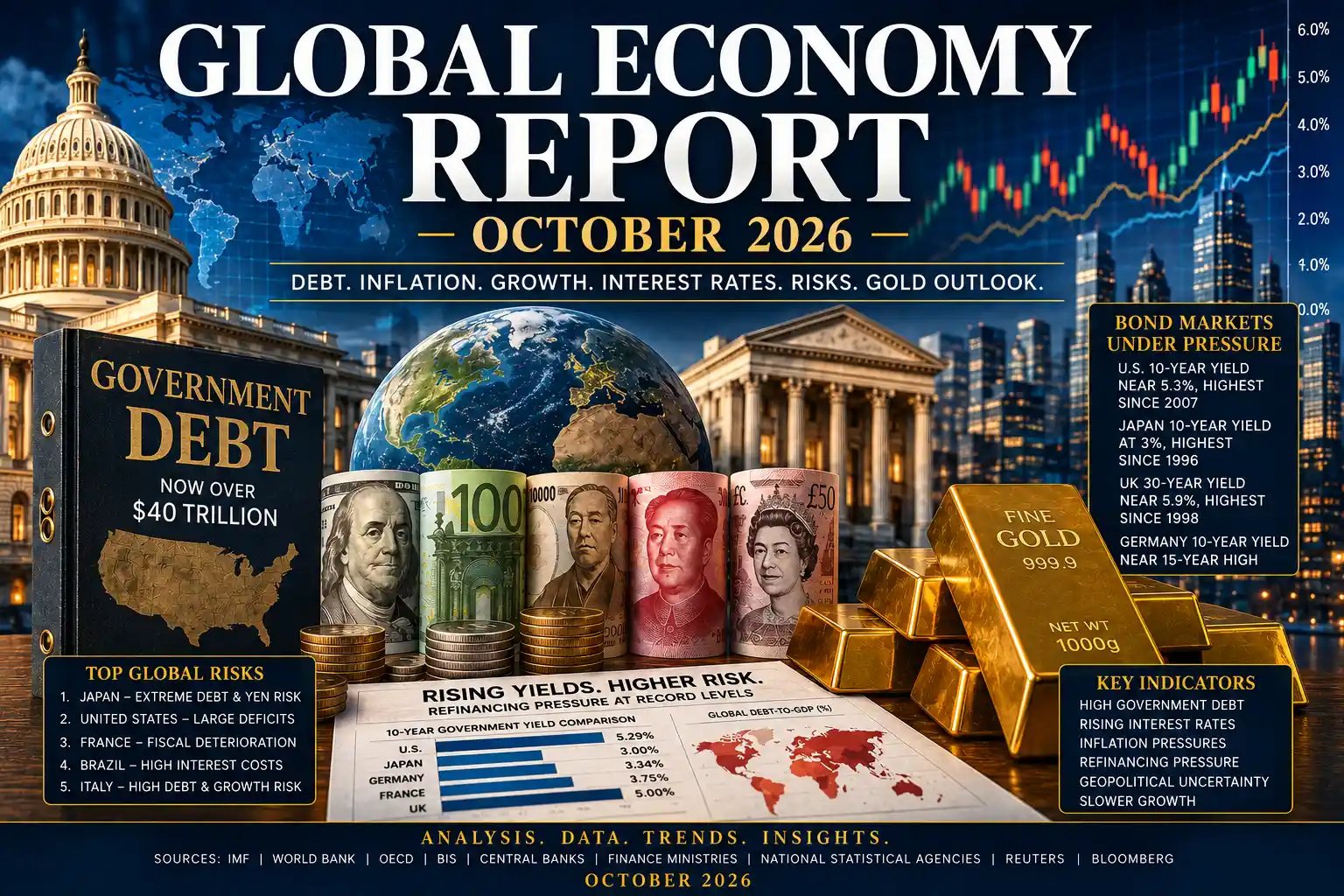
These decisions were a response to the return of inflationary pressures, particularly in energy markets. The consequences were immediate: yields on U.S. Treasury bonds reached levels not seen in years. The 10-year U.S. bond exceeded 5.29% at the end of September — the highest since 2007 — while the 30-year bond reached 5.62%, a level not seen since 2002.
The U.S. federal deficit reached about $2 trillion in the first 11 months of fiscal year 2026. The CBO estimates that the annual deficit will be around $1.9 trillion, or about 5.8% of GDP. Even more concerning: public debt service costs will exceed $1 trillion in 2026.
Yields above 5% have a direct impact on the entire economy. Higher borrowing costs translate into mortgages, business financing, commercial real estate, and municipal loans. CBO analysis shows the sensitivity of the situation: if rates are 1 percentage point higher than forecast, U.S. public debt could reach 222% of GDP by 2056, compared to 175% in the baseline scenario.
Japan, Italy, and France: Debt Exceeding the Economy
The global debt crisis is not limited to America. Japan has public debt at 203–204% of GDP — the highest among major economies. The Bank of Japan faces a difficult choice: maintaining low rates risks weakening the yen and a return of inflation, but raising them increases the costs of refinancing its massive debt.
In Italy, debt stands at 138% of GDP with a deficit rate of 2.9% of GDP. France is in an even more difficult situation: debt at 118.5% of GDP, a deficit of 5.2%, and growth of only 0.6%. This combination of high debt, large structural deficit, weak growth, and rising refinancing costs makes France the most vulnerable in the eurozone.
China, Brazil, and India: Extreme Rates and Currency Risk
In emerging markets, the situation is even more precarious. Brazil maintains a monetary policy rate of 14% — the highest among major economies — with public debt close to 100% of GDP. This combination means gigantic debt service costs.
China has kept its LPR (Loan Prime Rate) at 3.00%, but the economy has been slowing — growth slowed to 4.3% in the second quarter. Debt in the Chinese version, which includes local government obligations, significantly exceeds official statistics.
India faces a combination of inflation at 4.82% (above the central bank's target of 4%) and increasing pressure on the rupee. Importing 90% of its oil makes the Indian currency extremely sensitive to energy shocks, and high U.S. yields attract capital from poorer economies.
Sources
- #Finanse
- #DługiPubliczne
- #StopyProcentowe
- #Makroekonomia
- #KryzysFinansowy