Czech central bank raises key rate to 4% as inflation pressures build
The Czech National Bank raised its two-week repo rate by a quarter point to 4 percent on Thursday, the highest level since early 2025, citing the risk of faster price growth from energy costs and strong domestic demand.


In brief
- The Czech National Bank raised its key rate by 0.25 percentage points to 4 percent, the highest since early 2025.
- The bank cited energy costs and firm domestic demand as risks to faster inflation.
- Growth and inflation forecasts were revised, with 2026 GDP growth cut to 1.7 percent and 2027 inflation projected at 3.2 percent.
Rate increase largely expected by markets
The board of the Czech National Bank voted on Thursday to lift its two-week repo rate by 25 basis points to 4 percent (Česká národní banka zvýšila základní úrokovou sazbu na 4 procenta. Je nejvyšší od začátku roku 2025 – iROZHLAS) (ČNB zvedla základní sazbu na čtyři procenta – Novinky.cz). Bank communications director Jakub Holas confirmed the decision. Financial markets had broadly priced in the step, and lenders had already passed much of it into mortgage pricing ahead of the meeting.
Why the central bank is tightening
The main worry is the second-round effect, where high energy and fuel costs spill over into prices of goods and services (Czesi idą w inną stronę niż Polska. Raty kredytów momentalnie wzrosną – WNP.pl) (Není na co čekat. ČNB podle ekonomů zvýší sazby – Novinky.cz). Annual inflation had recently dropped below 2 percent, helped by cheaper food and a government decision in January to remove the renewable energy fee from household and business bills. Analysts say those factors are temporary. Core inflation, which excludes volatile items such as food and fuel, climbed above 3 percent already in September.
Forecasts for growth and inflation weakened
The bank's quarterly forecast lowered its outlook. It now sees GDP growth of 1.7 percent this year, down from 2.2 percent in August, and 2.5 percent next year, down from 2.7 percent (ČNB zhoršila výhled ekonomiky – Novinky.cz). Average inflation is projected at 2.1 percent this year and is expected to accelerate to 3.2 percent next year, 0.7 percentage points above the previous forecast. Inflation is seen easing to 2.3 percent in 2028.
Effects on borrowers and savers
Higher policy rates typically make loans dearer, including new mortgages and refinancing, while deposits can yield more (Hypotéky mohou zdražit, spoření vynášet víc. ČNB zvýšila sazby – Seznam Zprávy). Commercial banks had already pushed mortgage rates toward 6 percent in recent weeks. This is the second hike this year: the rate stood at 3.5 percent early in the year, rose to 3.75 percent in June, and was held there in August and September.
Contrast with Poland
Poland's Monetary Policy Council recently left interest rates unchanged, taking a different course from its Czech counterpart.
Read also
- Interest Rates May Rise Again: NBS Governor Warns of Costlier Energy and Returning Inflation
Sources
- [1]
 Není na co čekat. ČNB podle ekonomů zvýší sazby· Novinky.cz
- [2]
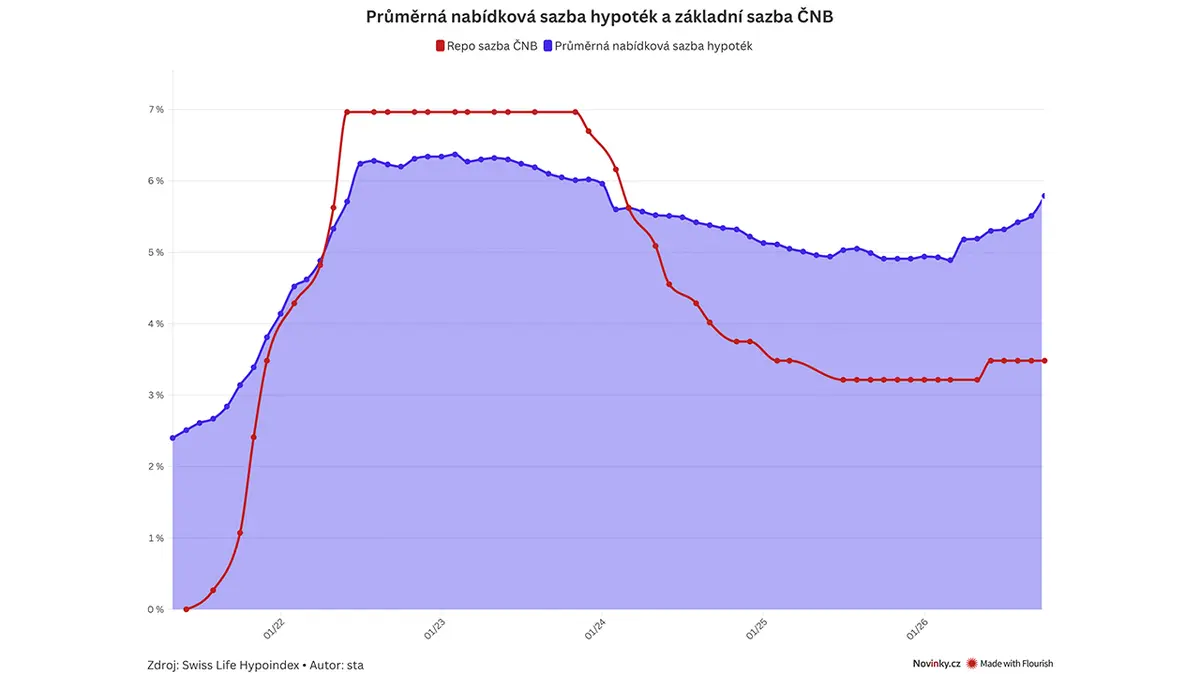 ČNB zvedla základní sazbu na čtyři procenta· Novinky.cz
- [3]
 Hypotéky mohou zdražit, spoření vynášet víc. ČNB zvýšila sazby· Seznam Zprávy
- [4]
 Česká národní banka zvýšila základní úrokovou sazbu na 4 procenta. Je nejvyšší od začátku roku 2025· iROZHLAS
- [5]
 ČNB zhoršila výhled ekonomiky· Novinky.cz
- [6]
 Czesi idą w inną stronę niż Polska. Raty kredytów momentalnie wzrosną· WNP.pl
- #CzechNationalBank
- #KeyInterestRate
- #RepoRate
- #Inflation
- #EnergyCosts
- #DomesticDemand
- #2026GDPForecast
- #CentralBankRateHike
Story graph
Connected stories
Czech central bank raises key rate to 4% as inflation pressures build
The Czech National Bank raised its two-week repo rate by a quarter point to 4 percent on Thursday, the highest level since early 2025, citing the risk of faste…